How Accurate Are SlopeFeel Wedges? The Math Behind the Slope
SlopeFeel wedges are engineered using trigonometry, not guesswork. Learn why your digital level might be lying to you — and why a physical wedge is the more reliable calibration tool.
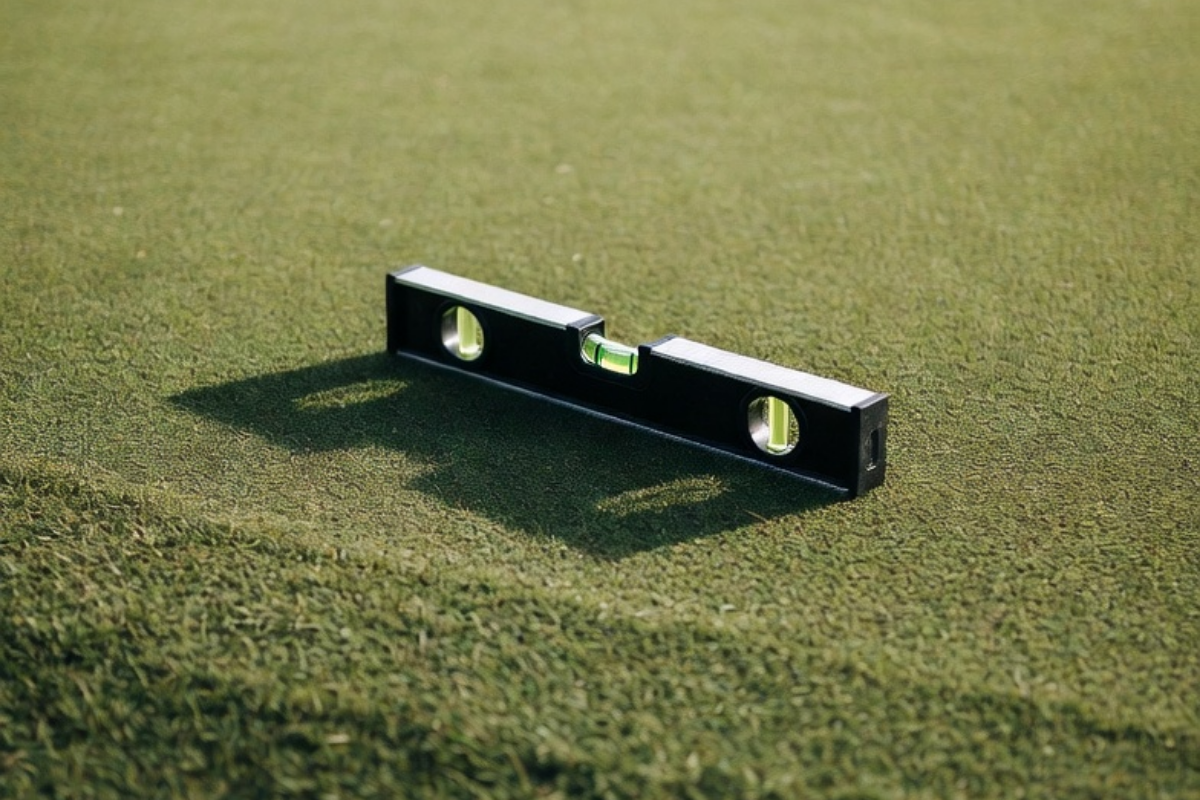
If you’re spending money on a training tool, you want to know it’s accurate. Fair enough — so do we.
One of the most common questions we get is: “How do I know these wedges are actually the right slope?” Sometimes people grab a digital level to check, and the reading doesn’t seem to match. That can be unsettling.
But before you doubt the wedge, it’s worth understanding two things: the math behind how each wedge is designed, and why a digital level can easily give you a misleading reading.
The Math: How We Engineer Each Wedge
Slope percentage is simple: it’s rise over run, expressed as a percentage.
A 2% slope means 2 inches of rise for every 100 inches of horizontal distance. To convert that into a precise angle, we use basic trigonometry:
Angle = arctan(slope percentage / 100)
Here’s what that looks like for each SlopeFeel wedge:
| Wedge | Slope | Angle |
|---|---|---|
| 1% | 1 in 100 | 0.573° |
| 1.5% | 1.5 in 100 | 0.859° |
| 2% | 2 in 100 | 1.146° |
| 2.5% | 2.5 in 100 | 1.432° |
| 3% | 3 in 100 | 1.718° |
Every wedge is 3D printed to within 0.1 degrees of its target angle. You can verify this yourself: grab a calculator, punch in arctan(0.02), convert to degrees, and you’ll get 1.146°. That’s the 2% wedge, dead on.
These are small angles — which is the point. Real greens break at subtle slopes. And that subtlety is exactly what makes getting fooled by a digital level so easy.
Why Your Digital Level Might Be Wrong
Digital levels are useful tools. But they have a critical requirement that most people skip: you have to zero the level on a perfectly flat, level surface before every use.
Here’s what happens when you don’t:
- Your kitchen floor has a 0.3° tilt (almost every floor does — you’d never notice it)
- You place the wedge on that floor
- You place your level on the wedge
- The level reads the wedge angle plus the floor angle combined
- The number on the screen doesn’t match the label
- You think the wedge is wrong — but it’s actually your floor
A 0.3° error on a 1.146° target (the 2% wedge) means you could read anywhere from 0.85° to 1.45° depending on which direction the floor tilts. That’s the difference between reading “1.5%” and “2.5%” on a slope that’s exactly 2%.
The level didn’t lie. It just measured the wrong thing.
Other common digital level pitfalls
- Degrees vs. percent confusion. Some levels display degrees, others display percent, and some toggle between modes. A 2% slope is 1.15° — if you’re reading degrees and expecting “2,” you’ll think it’s way off.
- Battery and calibration drift. Cheap digital levels lose accuracy over time, especially with low batteries. A $30 level from Amazon is not a metrology instrument.
- Surface contact. The level needs to sit perfectly flat on the wedge surface. Any debris, a grain of sand, or a warped level base throws the reading off.
Why the Wedge Is Actually the Better Tool
Think about it this way: a SlopeFeel wedge is a fixed physical angle. It’s geometry. It can’t drift, lose battery, need zeroing, or display the wrong unit. It is what it is — every single time you use it.
A digital level, on the other hand, is an electronic instrument that requires:
- A perfectly level reference surface to zero against
- Correct unit settings (degrees vs. percent vs. inches/foot)
- Fresh batteries
- Careful placement
- An understanding of what the number on the screen actually means
For slope perception training, you don’t need to measure slope. You need to feel it. The wedge gives you a known, repeatable slope to train against. That’s the whole point.
Your feet don’t care what number is on a screen. They care about consistency — and a precision-printed wedge delivers that every time.
Get the Most From Your Wedges: Surface Matters
To get accurate training from your SlopeFeel wedges, place them on a hard, flat surface:
- Hardwood, tile, or concrete — ideal
- Low-pile commercial carpet — acceptable (thin office carpet is fine)
- Thick carpet, rugs, or padding — avoid (the wedge can sink unevenly)
- Gravel, grass, or uneven ground — avoid (the base won’t sit flat)
The wedge angle is measured relative to the surface beneath it. If that surface is soft or uneven, the wedge can tilt or sink, and the slope you’re feeling won’t match the label. A hard floor eliminates that variable entirely.
The Bottom Line
SlopeFeel wedges are engineered from trigonometry, 3D printed to tight tolerances, and verified by hand. They don’t need batteries, zeroing, or a user manual.
If your digital level disagrees with the wedge, zero the level first. Then check again. We’re confident in what you’ll find.
Ready to train with tools you can trust? Shop SlopeFeel Kits →